How to Write and Deliver a Eulogy
The phone call came on a Tuesday. My mother had passed peacefully in her sleep, and within hours, my brother was asking me the question I'd been dreading for years: "Will you give the eulogy?"
I'm a grief counselor. I've helped hundreds of families through loss. I've attended more funerals than I can count. And yet, standing in my kitchen with my phone pressed to my ear, I felt completely paralyzed. How do you condense 68 years of a human life, your mother's life, into five minutes of words?

If you're reading this, you're probably facing something similar right now. Maybe you've just been asked to give a eulogy and you have no idea where to start. Maybe you've started writing but everything feels wrong. Maybe you're just looking for examples to inspire you.
Here's what I want you to know: Most people have never given a eulogy before. In my years as a grief counselor, I've worked with hundreds of families, and the vast majority have never stood at a podium to honor someone they love. You're not supposed to be an expert at this. And you being here, trying to do right by someone you love, already tells me you're going to be okay.
Quick Navigation
Click any section to jump directly to it
Free AI Eulogy Writing Assistant
Not sure where to start? Our AI-powered assistant creates a personalized eulogy draft based on your memories and preferences. Fill in as much or as little as you'd like. The more details you share, the more personal the result.
Free AI Eulogy Writing Assistant
Share memories • Get a personalized draft in minutes
Step 1: About Them
Tell us about the person you're honoring. All fields are optional—share as much or as little as you'd like.
For the service itself: a memorial slideshow
Add the photos everyone loves and watch it come together, set to music. Free to preview, $79.99 to download, or $349 and we build it for you.
How it works: The assistant uses AI (not generic templates) to weave your memories, stories, and preferences into a complete eulogy with a clear opening, body, and closing. You can regenerate as many times as you'd like until it feels right.
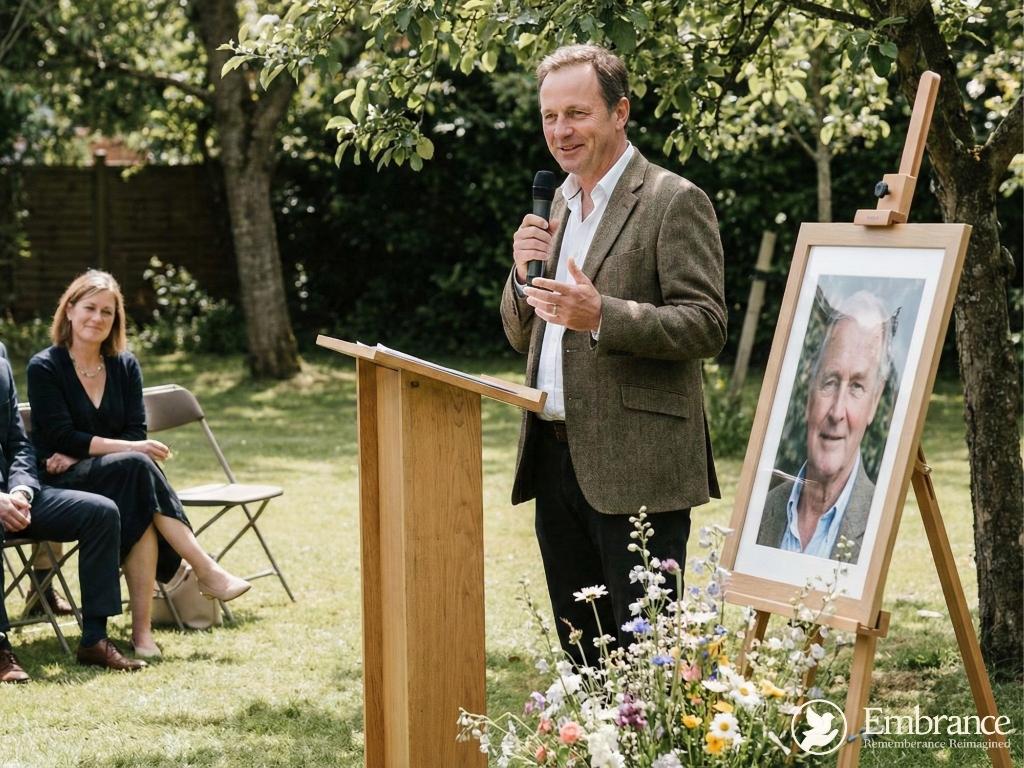
The Structure of a Great Eulogy
Every memorable eulogy I've witnessed shares a similar framework. Think of it like a three-act story: you hook them, you move them, and you send them off with something to carry forward.
Opening: Hook the Audience
The worst way to open a eulogy: "We are gathered here today..."
Everyone knows why they're gathered. This opening is so overused that it immediately signals "generic speech ahead." Instead, open with something that immediately transports people into a memory.
Powerful opening approaches:
1. Start with a specific moment:
"The last time I saw my father truly happy, he was elbow-deep in the engine of a 1967 Mustang, grease on his face, humming Johnny Cash. He looked up at me and said, 'This, kiddo. This is what heaven looks like.'"
2. Start with a question:
"How many of you have eaten my grandmother's apple pie? Raise your hands. That's what I thought. Half this room has been fed by that woman."
3. Start with who they were:
"My mother was the kind of person who would stop the car, literally stop the car in the middle of the road, to move a turtle to safety. And then she'd lecture us about the importance of kindness to all creatures for the next twenty minutes."
Body: Stories, Not Statements
This is where most eulogies go wrong. People make statements instead of telling stories.
The Specific Detail Rule: The more specific you are, the more universally moving your eulogy becomes. It sounds counterintuitive, but it's true.
Structure your body around 2-4 stories that illustrate different facets of who they were:
- A story that shows their character
- A story that makes people laugh (if appropriate)
- A story that shows their impact on others
- A story that encapsulates a lesson they taught
Closing: A Call to Memory
The ending is what people will remember most. Don't just trail off. Give them something to carry with them.
Effective closing approaches:
1. A direct address to your loved one:
"So, Dad, thank you. Thank you for the lessons, the laughter, the lectures about hard work. We'll take it from here. But save us a seat at your workbench."
2. A challenge to the living:
"If you want to honor my mother, do this: call someone you've been meaning to call. Write the letter you've been putting off. She believed we don't have time to waste. Prove her right."
3. A meaningful quote:
"There's a line from Mary Oliver that Mom loved: 'Tell me, what is it you plan to do with your one wild and precious life?' She lived her answer every single day. Now it's our turn to live ours."
4. A simple goodbye:
"We love you. We miss you. We'll carry you with us always. Rest now."
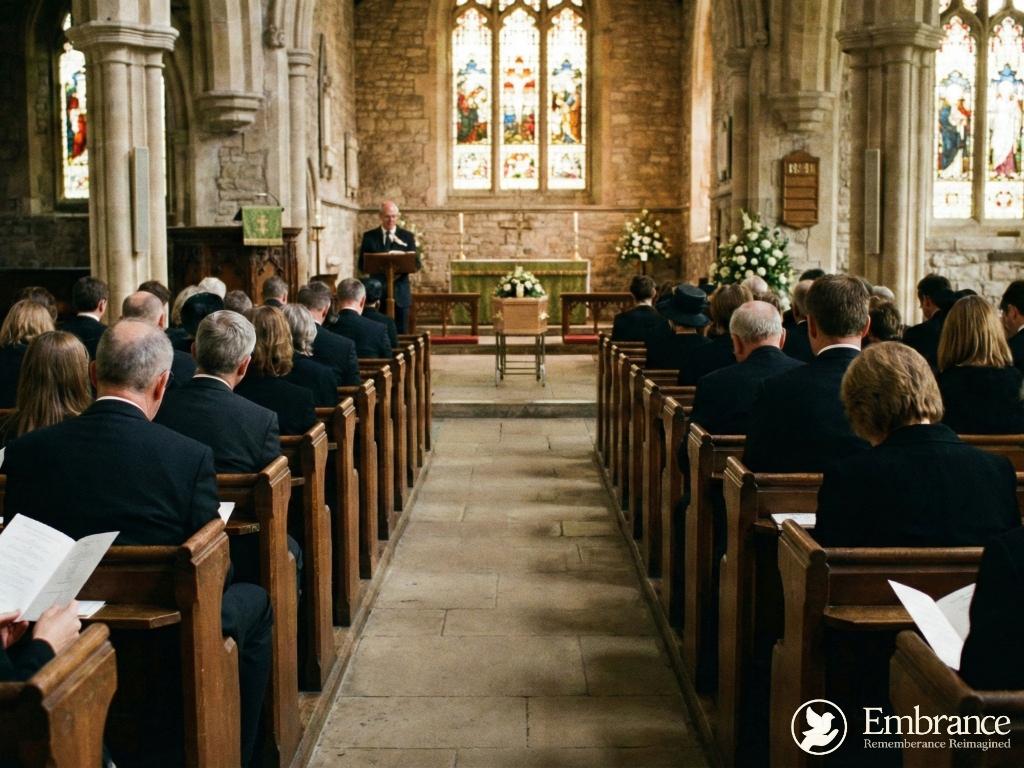
10 Real Eulogy Examples
Below are complete eulogies, not snippets. Each was written for a real person (names changed for privacy). Read them for inspiration, not as templates to copy.
For a Grandmother
My grandmother believed that love was a verb, not a noun. It was something you did, not something you felt.
She showed love by showing up. When my mother was diagnosed with cancer, Grandma (who was 78 years old and had never driven on a highway) got in her car and drove 300 miles to be there. When my cousin dropped out of college, Grandma didn't lecture. She hired him to help her "reorganize the garage" for three months until he figured out his next step. There was no garage reorganization happening. There was healing.
She made everyone feel like her favorite. I genuinely believed I was her favorite grandchild until her funeral, when I discovered all seven of us believed the same thing. That was her gift.
Grandma had rules. Shoes off in the house. No elbows on the table. And the most important one: you never leave hungry. Her refrigerator was legendary. I don't know how she did it, but there was always enough. Even if you showed up at 11 PM, there was enough.
She passed away in her sleep, in her own bed, in the house she'd lived in for 52 years. My grandfather's photo was on the nightstand. I like to think he came to walk her home.
Grandma, thank you for teaching us that love is a verb. We'll keep conjugating it. We love you. We miss you. Save us something in that refrigerator.
For a Father/Grandfather
My father was not a man of many words. He communicated through actions: through showing up, through building things, through the quiet presence of a man who was always, always there.
He worked at the steel mill for 34 years. Same shift, same parking spot, same lunch pail. He never complained about the work because, as he told me once, "Complaining doesn't make the steel lighter." That was Dad. Practical to the core.
But here's what you might not know: this man who barely spoke in public wrote letters. Dozens of them, to each of his children and grandchildren. I found them after he passed, tucked in a file cabinet labeled "Important." Letters for graduations. For weddings. For when we'd have children of our own. Letters I haven't opened yet because I'm not ready.
He taught me that silence can be generous. That showing up is more important than speaking up. That you can say "I love you" with a packed lunch, a fixed bicycle, a warm car engine on a cold morning.
Dad, I'll keep showing up. I'll keep the tools sharp and the oil changed. And when I run out of words, I'll remember that you never needed them anyway. Thank you for everything you built, including us.
For a Mother/Grandmother
My mother was a force of nature. She was joy distilled into 5'2" of unstoppable energy. She danced in grocery store aisles. She sang in the car: badly, joyfully, loudly. She believed that if you weren't embarrassing your children, you weren't parenting correctly.
She was also the strongest person I've ever known. When Dad left, she worked two jobs for six years while raising three kids. We didn't know we were struggling. She made sure of that. Only later did I realize why she made so many "soups" for dinner. She was stretching groceries with water and love.
Mom taught me that joy is a choice, not a circumstance. She had every reason to be bitter, but she chose laughter. She had every reason to give up, but she chose us.
In her final weeks, she made us promise three things: that we'd dance at her funeral, that we'd scatter some of her ashes at the beach she loved, and that we'd order the good champagne. We're keeping all three promises.
Mom, you didn't just raise us. You showed us how to live: with stubbornness, with joy, with a little chaos thrown in. We hear your laugh in our children. We see your dance moves in our living rooms. You're still here. Thank you for everything.
For a Spouse
Fifty-two years. That's how long I had with the love of my life. And it wasn't enough.
People ask me what the secret is to a long marriage. I wish I had something profound, but the truth is simple: we chose each other every day. Even when it was hard. Especially when it was hard.
Robert wasn't perfect. He left cabinets open constantly. He mixed darks with whites in the laundry until the day he died. He refused to ask for directions and added an extra hour to every road trip.
But he also left me love notes. Fifty-two years of marriage and he never stopped leaving notes. On the bathroom mirror. In my coat pocket. Tucked into my books. The last one I found said simply: "Still the one." I found it the morning after he passed. I keep it in my wallet now.
He was my best friend, my partner, my favorite person in every room. He made ordinary moments feel extraordinary. Walking to get the mail with him was an adventure. Watching him attempt to cook was a comedy show. Growing old with him was a privilege.
My darling Robert, I'll meet you on the other side. Save our spot on the porch. I love you. I'll always love you. Until then.
For a Young Person
Twenty-three years is not enough. It's not fair. And I'm not going to stand here and pretend to understand why.
But I can tell you this: in twenty-three years, Jamie lived more than most people do in eighty. He traveled to seven countries before he could legally drink. He started a nonprofit that's put 500 books in underserved classrooms. He made friends everywhere he went. And I mean everywhere. He once came home from a trip with a best friend he'd made on a bus in Guatemala.
Jamie was annoyingly optimistic. Offensively optimistic. The kind of person who genuinely believed that things would work out, even when evidence suggested otherwise. And the frustrating part? They usually did. For him, anyway.
He taught me to take the trip. To start the project. To talk to strangers. To believe that the world is mostly good, even when headlines say otherwise.
We don't get to know why his story was so short. But we get to decide how we continue it. Every book we donate is a chapter of his story. Every stranger we befriend is his legacy.
Jamie, you crammed so much life into your time here. We'll carry it forward. We'll take the trip. We promise.
For a Military Veteran
Colonel Thomas "Tommy" Reeves served his country for 32 years. Three tours in Vietnam. Two Bronze Stars. A Purple Heart that he kept in a shoebox in the closet because he said, "The real medals come home in flag-draped boxes."
My father never talked about the war. Not until his final years. And when he finally did, he didn't talk about heroics. He talked about the men he served with. He talked about their faces, their jokes, their families waiting at home. He remembered every single name.
He came home and built a quiet life. He coached Little League for 15 years, and some of those kids are here today, now with children of their own. He fixed things for widows in the neighborhood without being asked. He wrote letters to every soldier from our town who deployed, because he remembered what mail meant in a war zone.
Dad believed in service. Not the grand gesture kind, but the showing-up-every-day kind. He served his country in uniform, and he served his community in work boots and a flannel shirt.
Colonel Reeves, reporting for final rest. Your tour is complete. Your men are waiting. Semper Fi, Dad. We'll take it from here.
For Someone Funny
Let me tell you about the time my father accidentally became a local celebrity.
He was 67 years old and had recently discovered Facebook. He also discovered that he could leave reviews on things. Restaurants, hardware stores, his own house. One day, he left a review for a gas station that said, simply: "Excellent gasoline. Would pump again. 5 stars."
It went viral. He received a letter from the gas station thanking him. The local news called for an interview. He was baffled. "I was just being honest," he said. "It WAS excellent gasoline."
That was Dad. Genuinely, accidentally, magnificently funny. He wasn't trying to be funny. He just saw the world differently than the rest of us. He found joy in the ordinary and humor in the mundane.
He would hate that we're sad right now. He specifically told me, "If anyone cries at my funeral, I'm haunting them." So consider this a warning.
Dad, you made us laugh every single day. You made strangers laugh. You made gas station attendants laugh. You made the world a little lighter just by being in it.
Thank you for the gift of joy. We'll keep laughing. We promise.
For Someone Private
My mother was a private person. She didn't seek attention, didn't want fanfare, and would probably be mortified that we're all here talking about her right now. So I'll keep this brief. She would have liked that.
What I want you to know is this: she was quietly extraordinary.
She read a book a week for 40 years. She could identify any bird by its song. She remembered every birthday, every anniversary, every small detail you mentioned once in passing and never expected her to recall.
She loved deeply but expressed it in small ways. Fresh cookies on a hard day. A clipping from a magazine she thought you'd like. A phone call on the anniversary of something sad, just to say she was thinking of you.
She didn't need the world to know her. She needed only for her small corner of it to feel loved. And it did.
Mom, thank you for showing us that there's strength in stillness. That quiet love is still love. That listening is a superpower. We'll try to notice the birds. Rest peacefully.
For a Complicated Relationship
I'm going to be honest with you today, because my father valued honesty above almost everything else. Our relationship was complicated. We disagreed about almost everything: politics, life choices, the correct way to load a dishwasher.
We went years without speaking. More than once. There were holidays missed, phone calls not made, words said that couldn't be unsaid.
And yet, here I am. Because here's what I've learned: complicated love is still love.
My father was a difficult man. But he was also the man who taught me to ride a bike. The man who drove 12 hours to help me move into my first apartment. The man who, in the final months of his life, said words I'd waited 40 years to hear.
We don't get to choose our families. We don't get to choose whether the love comes easy or hard. What we get to choose is whether we show up anyway. We showed up for each other in the end. That has to count for something.
Dad, we didn't always understand each other. But I understand now that you loved me in your way, and I loved you in mine. I hope that's enough.
Rest now. We'll figure out the dishwasher without you.
Short Eulogy (Under 3 Minutes)
Everything I know about kindness, I learned from this woman.
My aunt never missed a birthday. Not one, in 45 years. She sent cards with messages that went on for pages. She remembered the name of every pet, every friend, every passing person you ever mentioned to her.
She volunteered at the hospital gift shop every Tuesday for 22 years. Not because she had to. Because she wanted to. "People need small kindnesses when they're scared," she said. "Anyone can do that."
She leaves behind no children, but she mothered everyone. She leaves behind modest means, but she was the richest person I knew. Her wealth was measured in cards sent, casseroles delivered, and quiet presence when things got hard.
Aunt Margaret, thank you for modeling what a life of service looks like. We'll keep sending the cards. We'll keep showing up. We love you.
How Long Should a Eulogy Be?
In my experience, 3-5 minutes is the sweet spot for most eulogies. That's approximately 450-750 words at a comfortable speaking pace of 150 words per minute.
| Length | Word Count | Best For |
|---|---|---|
| 2-3 minutes | 300-450 words | Secondary speakers, very private personalities |
| 3-5 minutes | 450-750 words | Most eulogies (recommended) |
| 5-8 minutes | 750-1,200 words | Primary speaker, very close relationships |
| 10+ minutes | 1,500+ words | Life celebrations, memorials with few speakers |
When longer is appropriate:
- You're the only person speaking
- The memorial is structured as a celebration of life
- The person had an unusually full life with many facets to cover
- Multiple stories are necessary to capture who they were
When shorter is better:
- Multiple people are giving eulogies
- The person was private and wouldn't want extended attention
- You're one of several speakers
- You're too grief-stricken to speak for long (which is completely valid)
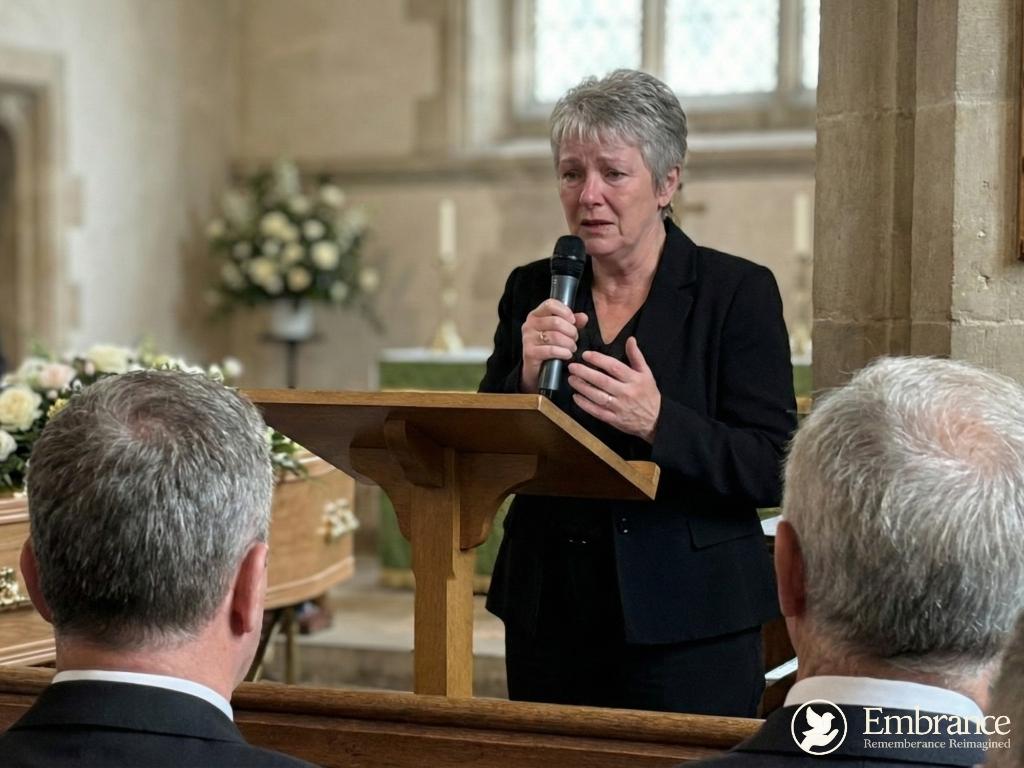
Delivery Tips
Managing Emotions
It's okay to cry. Let me say that again: it is completely, entirely, humanly okay to cry while delivering a eulogy. You're speaking about someone you loved at their funeral. Emotion is not weakness. It's evidence of love.
Still, here are some strategies if you want to maintain composure:
- Practice reading it aloud several times. The more familiar you are with the words, the less likely you are to be blindsided by emotion.
- Mark the emotional parts. Put a star next to sections that make you tear up, so you can prepare yourself before you get there.
- Pause, breathe, continue. If you feel overcome, stop speaking. Take a breath. Take a sip of water. The audience will wait.
- Have a backup reader. Give a copy to someone who can step in if you can't continue.
Pacing and Pauses
One of our customers, Sarah from Denver, told me: "I was rushing through my grandmother's eulogy like I was late for a meeting. Then I paused to take a breath, and I saw people nodding, wiping tears. That silence wasn't awkward. It was everyone remembering her together."
Don't rush. Allow moments of silence after significant points. Let the words land. Silence in a eulogy isn't empty. It's sacred space for remembering.
- Speak slower than feels natural
- Pause after stories to let images settle
- Make eye contact (or look at foreheads if eye contact is too intense)
- Breathe between paragraphs
What to Do If You Break Down
Have a plan. Before you start:
- Give a printed copy to someone in the front row
- Ask them to be ready to continue if you signal
- Know that it's okay to signal
If you break down mid-eulogy:
- Pause
- Take a breath
- Take a sip of water
- If you can continue, continue
- If you can't, hand off the copy with grace
No one will judge you. Everyone will understand.
Practicing Beforehand
I cannot stress this enough: practice out loud. Reading silently is not the same as speaking. You need to:
- Hear how the words sound
- Identify tongue-twisters or awkward phrases
- Find your emotional trigger points
- Time yourself accurately
- Build muscle memory so your mouth knows what to do even if your brain freezes
Practice in front of a mirror. Practice for a trusted friend. Practice in the car. Practice.
Real Stories from Our Customers
"I had 72 hours to write my dad's eulogy"
Linda T., Austin, Texas
"I found the AI assistant at 11 PM on Thursday. The funeral was Sunday morning. I'd been staring at a blank page for three hours, crying more than writing. The tool asked me questions I hadn't even thought about: What made your dad laugh? What lesson did he teach you? Within 20 minutes, I had a draft that captured him perfectly. I tweaked it for another hour, adding more personal details, and practicing it out loud. At the funeral, three people told me it was the most beautiful eulogy they'd ever heard. I couldn't have done it without this starting point."
"It helped me organize 82 years into 6 minutes"
James K., Portland, Oregon
"My grandmother lived a full 82 years. I had hundreds of stories, but no idea how to structure them without it sounding like a rambling biography. The AI assistant helped me pick the three most important memories and weave them into a narrative. I didn't use the generated text word-for-word (I made it my own), but having that framework was everything. It turned chaos into clarity."
"I'm not a writer. This made me feel like one."
Maria S., Phoenix, Arizona
"I work in construction. I barely passed English class. When my brother asked me to give our mom's eulogy, I almost said no. But I used this tool, and it helped me find words I didn't know I had. It asked about specific moments, and suddenly I was remembering things I'd forgotten, like how Mom always sang to her plants, or how she made the world's worst coffee but we all drank it anyway. The tool gave me confidence. I could do this."
Sharing It at the Service
A eulogy gives the room words to hold onto. A memorial slideshow gives them the faces and moments behind those words, playing quietly as everyone gathers. Many families pair the two.
Frequently Asked Questions
Who typically gives the eulogy?
There's no strict rule. Eulogies are commonly given by:
- Immediate family members (spouse, children, siblings)
- Lifelong friends
- Colleagues who knew them well
- Clergy or a celebrant (though they often invite family to speak)
- Sometimes multiple people share the responsibility
The best person to give a eulogy is whoever knew your loved one well and feels comfortable speaking. It's okay to decline if you don't feel able.
Can more than one person give a eulogy?
Yes. It's increasingly common for 2-4 people to share eulogy duties, and that can be a relief. You don't have to capture everything about a person's life yourself.
When multiple speakers are involved:
- Coordinate topics to avoid repetition
- Assign different "chapters" (childhood friend covers early years, colleague covers career, etc.)
- Keep individual eulogies shorter (2-4 minutes each)
- Decide on a speaking order that makes narrative sense
Is it okay to use humor in a eulogy?
Yes, when appropriate. If the person was known for their sense of humor, a eulogy without laughter would feel incomplete. The key is to be respectful. You're celebrating who they were, and if "who they were" was funny, honor that.
Tips for humor in eulogies:
- Tell stories that naturally lead to laughter rather than crafting "jokes"
- Gauge the room. Some services are more formal than others
- Humor should celebrate the person, not mock them
- It's okay if people laugh AND cry in the same eulogy
Should I memorize the eulogy?
No, and I strongly advise against it. Emotions are unpredictable at funerals. Having your written text in front of you:
- Provides a safety net if emotion overwhelms you
- Reduces anxiety about forgetting
- Allows you to look up and make eye contact knowing you can always look back down
- Is completely normal and expected
Print your eulogy in large, readable font. Double-space it. Number your pages. Bring a pen to mark where you are if you need to pause.
What if I can't finish the eulogy?
Have a backup plan:
- Give a printed copy to someone you trust
- Brief them beforehand: "If I signal you, please take over"
- Sit near them
If you can't continue, you can:
- Signal your backup to step in
- Simply say "I'm going to have [Name] finish for me" and hand over the pages
- Take a long pause and try again
- End where you are. No one will think less of you
What NOT to Write (Avoid These Phrases)
Just as important as what to say is what NOT to say. Here are phrases that, despite good intentions, can feel dismissive or hurtful:
- "Everything happens for a reason": This implies their death had a purpose, which can feel invalidating
- "I know exactly how you feel": You don't. Each person's grief is unique
- "They're in a better place": This can minimize the loss, especially for those struggling with faith
- "At least they lived a long life": Loss is loss, regardless of age
- "Time heals all wounds": Time helps, but some wounds leave scars
- "Be strong": This suggests they shouldn't show grief
Instead, try:
- "Their memory will always be with you"
- "I'm thinking of you during this difficult time"
- "They were loved, and they'll be missed"
Need help finding the right words for sympathy cards too? After the funeral, many attendees will want to reach out. Our complete guide to writing sympathy cards includes 75+ examples for every situation.
Is this AI tool really free?
Yes, completely free with no signup required, no credit card, no hidden fees. We built this tool because we believe that during one of life's hardest moments, you shouldn't have to struggle alone to find the right words. Use it as many times as you need.
Cultural and Regional Considerations
While grief is universal, how we honor the people we've lost varies by culture, religion, and even geography. Here's what we've learned from working with thousands of families:
Religious Traditions
Christian Funerals: Eulogies often include scripture readings, references to eternal life, and expressions of faith. It's common to close with "until we meet again" or similar sentiments of reunion in heaven.
Jewish Tradition: The hesped (eulogy) is typically brief and focuses on the person's virtues and good deeds. It's customary to avoid excessive praise that might seem insincere. In Orthodox traditions, eulogies may be limited or omitted entirely.
Islamic Custom: Eulogies (ta'ziyah) are less common in traditional Islamic funerals. When given, they emphasize the person's piety, good character, and devotion to faith. The focus is on the soul's journey and Allah's mercy.
Hindu Tradition: Eulogies may reference karma, the soul's journey, and reincarnation. There's often emphasis on celebrating the person's dharma (righteous living) and their spiritual path.
Buddhist Practice: Eulogies tend to be brief and focused on the impermanence of life, the person's compassion, and their path toward enlightenment. Emphasis on non-attachment while honoring memory.
Regional Variations We've Observed
Southern United States: Eulogies often run longer (8-12 minutes), with more personal storytelling, humor when appropriate, and emphasis on community. It's common to reference shared meals, church community, and "homegoing" language.
Northeast: Tends toward more formal, structured eulogies (4-6 minutes). Often more reserved emotionally, with emphasis on accomplishments and legacy.
Rural Communities: Frequently includes references to the land, seasons, and shared experiences specific to small-town life. Agricultural or ranching metaphors are common.
Urban/Coastal Areas: More likely to include diverse cultural references, non-traditional formats, and celebration-of-life elements over traditional mourning.
Important Note: These are patterns, not rules. Your eulogy should reflect the individual person and what your family needs. When in doubt, ask the funeral director or family members about any cultural expectations.
A Helpful Resource for Your Grief Journey
If you're in the early days of loss, this gentle guide offers day-by-day suggestions to help you through. It's a companion for the hardest moments: reminders that you're not alone and small steps you can take each day.
Free Guide: 'The First 30 Days'
Grief doesn't follow a schedule, but having a gentle guide can help. This resource offers small, manageable suggestions for each day of the first month, when the world expects you to 'move on' but your heart isn't ready.
🔒 We never share your information with anyone.
Final Thoughts
I want to leave you with something that took me years of grief counseling to fully understand:
There is no perfect eulogy.
There are words that capture a moment. There are stories that make people laugh through tears. There are tributes that leave people feeling closer to someone who's gone. But there is no magical formula, no secret structure, no "right" thing to say.
What matters is that you show up. That you speak from love. That you try to honor someone who mattered to you.
The person you're writing about didn't need perfection from you when they were alive. They don't need it now. They just need you to stand up and say, in your own imperfect words, that they mattered.
You've got this. And they would be proud that you're even trying.
Now go write that eulogy.
One practical note before you go. The person writing the eulogy is very often the person asked about the slideshow too. If you would rather hand that part to someone, who can make a funeral slideshow for you sets out who builds them, what they charge, and what to say about your service date. If you would rather build it yourself, the best memorial slideshow makers, compared lays out the tools and their prices.
Create a memorial slideshow
Add your favorite photos and watch a tribute come together live, set to music. Free to preview.